
How Much Does Concrete Slab Removal Cost in San Antonio? (2026 Price Breakdown)
Staring at a cracked concrete slab in your San Antonio backyard and wondering what it’ll cost to get rid of it? You’re not alone. Every week, homeowners across Bexar County face the same question when old garage slabs, deteriorating patios, or damaged foundation pads reach the point where removal makes more sense than ongoing repairs. Understanding what concrete slab removal actually costs helps you budget realistically and avoid the sticker shock that comes from underestimating this necessary but often expensive project.
The short answer is that concrete slab removal in San Antonio typically costs between six and ten dollars per square foot for complete removal including breaking, hauling, and site cleanup. But that range expands significantly based on factors specific to your property and the condition of the concrete you need removed. A small 100 square foot shed pad might cost $600 to remove, while a large 600 square foot driveway removal project could easily reach $6,000 for thorough demolition and proper site preparation.
What You Actually Pay Per Square Foot
The per square foot pricing model makes sense for concrete work because it accounts for the reality that larger slabs take proportionally more time, generate more debris, and involve greater disposal costs than smaller ones. In 2026, most professional concrete slab removal contractors in San Antonio charge between $6 and $10 per square foot for standard residential work. This pricing includes everything from the initial breaking through final site grading.
Where you fall within that range depends primarily on concrete thickness and reinforcement density. A simple four inch residential slab with basic wire mesh reinforcement sits at the lower end around $6 per square foot. Thicker six inch slabs with heavier rebar throughout push toward $8 per square foot. Commercial grade eight inch slabs with extensive steel reinforcement can reach $10 per square foot or higher because the extra thickness and steel require more powerful equipment and significantly more time to break apart completely.
The square footage itself drives your total cost more than any other single factor. A typical single car garage slab measuring roughly 200 square feet costs $1,200 to $2,000 for complete removal at standard rates. Double that to 400 square feet for a two car garage and you’re looking at $2,400 to $4,000. A large patio demolition project covering 500 square feet runs $3,000 to $5,000 for thorough removal and cleanup.
Breaking Down What’s Included in Professional Pricing
When contractors quote you a price for concrete slab removal, understanding what that number actually covers prevents confusion later when the work begins. Professional pricing should include every step from initial breaking through final cleanup, not just the dramatic part where heavy equipment pounds through concrete.
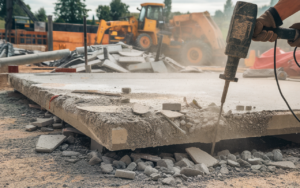
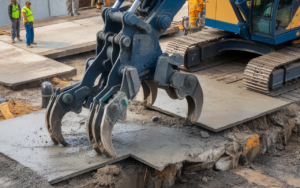
The breaking phase involves using jackhammers for smaller areas or hydraulic breakers mounted on excavators for larger slabs. This equipment rental or ownership cost gets built into contractor pricing along with the skilled labor to operate machinery safely and efficiently. Breaking concrete isn’t just randomly smashing until it falls apart. Experienced crews work systematically to fracture slabs into manageable pieces while cutting through reinforcing steel as they progress.
Loading and hauling represents a substantial portion of total cost because concrete is extraordinarily heavy. A modest 200 square foot slab four inches thick generates roughly three tons of debris. That material must be loaded into trucks using excavators or skid steers, then hauled to disposal facilities that charge by weight. Multiple truck loads mean multiple disposal fees, and the distance from your property to approved facilities affects how many loads contractors can complete in a day.
Disposal fees at San Antonio area facilities typically run $40 to $60 per ton for concrete debris. Some contractors route material to concrete recycling facilities that charge slightly less than landfills while supporting environmental responsibility. Either way, disposal costs for even modest slab removal projects easily reach $500 to $1,500 depending on total debris weight.
Site cleanup and grading complete professional slab removal service. After concrete is gone, contractors grade the area to proper elevations for drainage, remove scattered concrete fragments, and leave your property with clean ground ready for whatever comes next. This final phase often separates professional contractors from those who consider the job done once visible concrete disappears, leaving you with depressions, debris, and inadequate site preparation.
Hidden Costs That Surprise Property Owners
Beyond the basic per square foot pricing, several factors add cost to concrete slab removal projects in ways homeowners don’t always anticipate during initial planning. Understanding these potential extras helps you budget more accurately and prevents financial surprises midproject.
Access challenges significantly affect costs when slabs sit in locations where large equipment can’t work efficiently. Backyard slabs accessible only through narrow side gates require smaller equipment or even hand breaking in extreme cases. This reduced efficiency translates directly to higher labor costs because the work takes longer with less capable tools. Properties where trucks must park on the street and debris gets hauled around houses or through tight spaces add hours to projects that would complete quickly with direct equipment access.
Thicker than expected concrete catches some property owners off guard when contractors discover that what appeared to be a standard four inch slab actually measures six inches or more in certain areas. This extra thickness wasn’t visible before breaking began, but it definitely affects how long removal takes and how much debris requires disposal. Honest contractors adjust pricing when they encounter these surprises, while less scrupulous ones might have underbid initially knowing they’d claim extras later.
Rebar density beyond what’s typical for residential work increases breaking difficulty and time requirements. Standard residential slabs use wire mesh or minimal rebar for reinforcement. Slabs poured with commercial specifications or by homeowners who over-engineered their projects contain heavy rebar on tight spacing that must be cut repeatedly as concrete fractures. This additional steel cutting slows progress and wears through cutting equipment faster.
Tree root penetration beneath slabs creates removal complications in older San Antonio neighborhoods where mature trees have had decades to extend roots under concrete. Fence removal projects sometimes encounter this same issue where tree roots have invaded beneath fence footings. Breaking through concrete reveals root masses that must be addressed before proper site grading can happen. Some contractors include basic root cutting in their slab removal pricing while others charge extra for extensive root management.
Base material removal adds cost when you need more than just the concrete surface removed. Some slabs sit on several inches of compacted gravel or crushed stone base. If you’re converting the area to landscaping or if new construction requires different base preparation, removing that material along with the concrete increases the scope and cost of your project.
San Antonio Specific Factors Affecting Your Cost
Our local conditions create cost variables that property owners in other regions don’t necessarily face. Understanding these San Antonio specific factors helps you evaluate quotes more accurately and recognize when contractors are accounting for real challenges versus padding estimates.
Expansive clay soil throughout the San Antonio area affects concrete slabs over time, creating the cracking and heaving that often necessitates removal. When contractors break up slabs damaged by soil movement, they’re also dealing with uneven surfaces where some sections have heaved while others settled. This irregularity makes breaking less predictable and sometimes requires different approaches for different areas of the same slab.
Summer heat in San Antonio affects project scheduling and worker productivity in ways that influence costs. Contractors working during peak summer months often start very early to complete physically demanding concrete breaking before temperatures climb into triple digits. This shift in scheduling can affect how much work crews complete per day, and some contractors charge premium rates for summer projects when heat stress becomes a serious worker safety concern.
Disposal facility locations relative to different San Antonio neighborhoods affect hauling efficiency. Properties near concrete recycling facilities on the city’s edges benefit from shorter haul distances that let contractors complete more loads per day. Properties in areas requiring longer drives to approved disposal sites face higher costs because contractors spend more time hauling and less time breaking concrete on your property.
Permit requirements add cost in most San Antonio concrete slab removal projects, though the fees themselves are relatively modest compared to overall project expense. Contractors typically include permit acquisition in their pricing rather than treating it as a separate line item. The administrative time to submit applications and coordinate inspections gets built into overall project cost along with the actual permit fees paid to the city.
Estimating Your Specific Project Cost
Armed with understanding of how contractors price concrete slab removal, you can estimate your project cost more accurately before ever calling for quotes. Start by measuring your slab’s square footage as precisely as possible. Length times width gives you the total area requiring removal.
Multiply your square footage by a rate between $6 and $10 depending on what you know about your slab. If you’re confident it’s a standard four inch residential pour, use $6 to $7 per square foot. If you know it’s thicker or heavily reinforced, estimate toward $8 to $10 per square foot. A 300 square foot slab at $7 per square foot estimates to $2,100 for basic removal.
Add 15 to 20 percent contingency for unexpected conditions because concrete work almost always reveals surprises once breaking begins. That $2,100 estimate becomes $2,400 to $2,500 with appropriate contingency built in. This buffer protects you from budget shortfalls when contractors encounter thicker concrete, additional reinforcement, or challenging access you didn’t account for initially.
For projects involving multiple concrete elements, estimate each separately then combine totals. Removing both a patio demolition area and a walkway requires calculating square footage for each surface and applying appropriate rates. Don’t forget to account for any concrete footings, piers, or below grade elements that need removal along with visible slabs.
Getting Accurate Contractor Quotes
Rough estimates help with initial budgeting, but getting firm quotes from experienced contractors provides the accurate numbers you need for actual project planning. When requesting quotes, provide contractors with detailed information that lets them estimate accurately without lowering bids based on optimistic assumptions.
Measure and communicate exact square footage rather than rough guesses. Contractors appreciate property owners who’ve done this homework because it shows you understand how pricing works and that you’re serious about the project. If you know your concrete thickness from construction documents or direct measurement through existing cracks, share that information.
Describe access conditions honestly including gate widths, distances from street parking to the slab location, and any obstacles contractors must work around. Properties with challenging access benefit from contractor site visits where they can evaluate conditions directly, but detailed descriptions help even during initial phone or email conversations.
Ask what’s included in quoted prices to ensure you’re comparing equivalent proposals from different contractors. Some quotes include permits and all fees while others exclude these items. Some contractors include complete site grading and cleanup while others consider the job done once concrete is loaded and hauled. Understanding exactly what each quote covers prevents comparing apples to oranges.
Request breakdown of square footage rates and disposal fees separately when possible. This transparency helps you understand where your money goes and makes it easier to evaluate whether quotes are reasonable. Contractors willing to provide this detail demonstrate professionalism and give you confidence they’re not hiding padding in vague lump sum pricing.
When Low Bids Should Raise Concerns
Receiving quotes that vary significantly from multiple contractors tempts property owners to simply accept the lowest number and move forward. But in concrete slab removal, suspiciously low bids often signal problems that cost more to fix than you would have saved by choosing the cheap option initially.
Contractors who consistently bid well below market rates either don’t understand the actual work involved, plan to cut corners on disposal by dumping debris illegally, or intend to hit you with change orders for “unexpected” conditions they should have anticipated. None of these scenarios benefits you as the property owner.
Legitimate contractors price projects to cover their actual costs for equipment, labor, disposal, insurance, and appropriate profit margin. When someone bids dramatically lower than competitors, they’re either losing money on your project or not planning to deliver the same quality of service that properly priced contractors provide.
Compare the middle range of quotes you receive rather than automatically accepting the lowest. If you get bids of $3,000, $3,200, $3,400, and $2,100, the outlier at $2,100 deserves skepticism not celebration. The cluster around $3,000 to $3,400 represents realistic pricing from contractors who understand the work and price it appropriately.
Planning Your Budget and Timeline
Concrete slab removal represents a significant expense for most homeowners, but planning appropriately makes the cost manageable and prevents this necessary work from derailing larger renovation or construction projects. Build 10 to 15 percent contingency into your total budget specifically for site preparation and demolition work because conditions underground and within existing structures almost always include some surprises.
If you’re removing slabs as preparation for new construction, coordinate timing carefully with your builder or contractor handling the next phase. Completing concrete slab removal too far ahead of construction leaves exposed ground vulnerable to erosion during rains or vegetation regrowth requiring additional clearing. Scheduling slab removal shortly before new work begins maximizes efficiency.
For projects where you’re converting slab areas to landscaping or other non-construction uses, expect some soil settling over the weeks following removal. Ground that was compressed under concrete weight for decades gradually relaxes after that weight disappears. Plan to add fill dirt and regrade after a few months if you’re establishing lawn or extensive landscaping in former slab locations.
Consider seasonal timing when budgeting projects. Summer months bring heat that affects worker productivity and sometimes results in premium pricing. Late fall through early spring offers more moderate working conditions and sometimes more competitive pricing as contractors look to fill schedules during slower seasons. However, winter rains can delay concrete removal when ground becomes too muddy for heavy equipment operation.
Getting old concrete slabs removed properly costs real money, but understanding what drives those costs helps you budget accurately and make informed decisions about contractors and timing. Whether you’re removing a small shed pad or a large driveway, realistic pricing expectations prevent the frustration and delays that come from underestimating this essential preparation work.